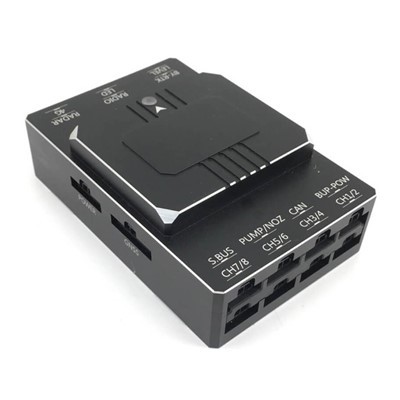


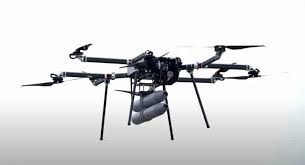
Definition
Unmanned aerial vehicle radar is a microwave radar detection system integrated on the unmanned aerial vehicle platform, which detects and perceives the distance, speed, orientation, and contour of targets by emitting and receiving electromagnetic waves. It is not limited by lighting, haze, rain, snow, and other conditions and is mainly used for unmanned aerial vehicle autonomous obstacle avoidance, altitude navigation, target monitoring, terrain mapping, and environmental perception tasks.
Main types
Millimeter wave radar
Working in the millimeter wave frequency band, with small size and light weight, it is currently the most commonly used radar type for small unmanned aerial vehicles, mostly used for close range obstacle avoidance and height determination.
01
LiDAR
Although often classified as optical perception devices, they are often mentioned alongside radar in drone applications, achieving high-precision 3D environment modeling and obstacle recognition through laser pulses.
02
Synthetic aperture radar
Belonging to professional airborne imaging radar, it utilizes the flight path of unmanned aerial vehicles to synthesize large aperture antenna effects, which can achieve long-distance, high-resolution ground imaging and is commonly used for surveying and reconnaissance.
03
Doppler radar
The Doppler effect is mainly used to measure the relative velocity and altitude between unmanned aerial vehicles (UAVs) and the ground or targets, and is commonly used for UAV altitude determination, stable flight, and terrain tracking.
04
Low altitude surveillance/anti drone radar
It is commonly used on ground or large unmanned aerial vehicle platforms, specifically for detecting "low, slow, and small" targets in the air, achieving the discovery, tracking, and early warning of unmanned aerial vehicles.
05
Feature
■ 24/7 working ability
It can work normally in harsh environments such as night, rain, fog, and dust, without being affected by light, making up for the shortcomings of visible light cameras.
■ Accurate ranging and speed measurement
It can simultaneously obtain target distance, speed, and angle information, with fast response speed and strong stability.
■ Strong anti-interference ability
Compared to visual sensors, it is less affected by smoke, dust, and strong light interference and has higher reliability.
■ There is a significant difference in volume and power consumption
Small obstacle avoidance radar is lightweight and low consumption, suitable for multi rotor unmanned aerial vehicles; Large SAR radar and surveillance radar have large volumes and high power consumption, and are often used for fixed wing or large unmanned aerial vehicles.
■ There is a significant difference in penetrability and imaging ability
Millimeter waves can slightly penetrate obstructions, synthetic aperture radar can penetrate vegetation and clouds to achieve ground imaging, and laser radar focuses on high-precision 3D modeling.
■ High degree of autonomy
It can cooperate with flight control to achieve automatic obstacle avoidance, automatic altitude determination, and automatic route planning, enhancing the intelligence level of unmanned aerial vehicles.
Scope of application
Autonomous obstacle avoidance by unmanned aerial vehicles
Suitable for urban flight, building inspection, logistics distribution, curtain wall cleaning and other scenarios, to prevent drones from colliding with obstacles such as walls, cables, trees, etc.
Drone altitude control and stable flight
Used for agricultural crop protection, aerial photography, and low altitude operations, ensuring that drones maintain stable altitude in complex terrains.
Surveying and Exploration
Synthetic aperture radar and LiDAR are used for land surveying, geological exploration, post disaster monitoring, and forest resource investigation.
Security and Surveillance
Used for low altitude security in airports, scenic spots, important venues, and border areas, detecting illegal flying drones, and achieving early warning and control.
Industrial inspection
Power line inspection, oil and gas pipeline inspection, bridge inspection, commercial square curtain wall inspection, accurately identify equipment defects and environmental obstacles in complex environments.
Military and Special Operations
Target reconnaissance, border patrol, covert target detection, and intelligence acquisition tasks under complex weather conditions
Hot Tags: unmanned aerial vehicle radar, China unmanned aerial vehicle radar manufacturers, factory, Drone Water Pump, Unmanned Aerial Vehicle Radar, Unmanned Aerial Vehicle Flight Control System, drone accessories, Long endurance Battery For Drones, Drone Remote Controller