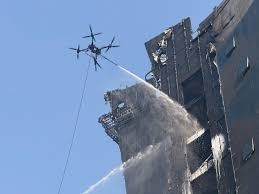
With the continuous expansion of the global low-altitude economic industry chain and the in-depth intelligent transformation of traditional industries, the market demand for professional aerial operation equipment is undergoing profound changes. Traditional industrial drones mostly adopt fixed-point hovering and fixed-route cruise modes, which can only complete simple and conventional aerial shooting and patrol tasks. When facing complex and narrow working scenarios such as dense industrial factory areas, building interior structures, urban narrow streets, power transmission line corridors and mountainous terrain, they are prone to problems including inflexible steering, slow response, difficulty in penetrating obstacles and blind inspection areas, which cannot meet the high-standard operation requirements of modern industrial inspection, emergency rescue and fine urban management. To solve the industry's long-standing technical bottlenecks and application pain points, the newly launched industrial-grade FPV drone has achieved comprehensive breakthroughs in flight performance, intelligent perception, environmental adaptability and task execution capability. Adopting professional first-person view flight control technology, the drone supports real-time high-definition image transmission with zero delay, allowing ground operators to grasp the on-site flight environment and operation status in an all-round and intuitive manner, realizing human-machine integrated precise control. Compared with traditional industrial UAVs, it has extremely outstanding agile maneuvering performance, capable of completing rapid acceleration, sharp turning, obstacle avoidance penetration and ultra-low altitude close-range flight stably and flexibly, perfectly adapting to various complex and narrow space scenarios that are difficult for ordinary drones to access. In terms of core performance configuration, this industrial FPV drone is equipped with a high-sensitivity intelligent sensing system and multi-dimensional anti-collision recognition module, which can automatically identify surrounding obstacles, plan optimal flight routes and realize active obstacle avoidance and autonomous cruise flight. Built-in strong anti-electromagnetic interference and wind resistance structure, it can maintain stable flight and stable signal transmission in complex environments such as strong electromagnetic interference of power facilities, strong wind in open areas and dim light in closed spaces, effectively avoiding flight jitter, signal loss and mission interruption. In terms of practical application scenarios, the drone has realized full-scenario coverage of industrial and public service fields. In the power industry, it can penetrate dense power tower facilities and line corridors to conduct close-range fine inspection of power equipment, accurately capture tiny defects such as line aging, insulator damage and loose parts, and greatly improve the accuracy of power safety hidden danger investigation. In the field of urban security and emergency rescue, it can quickly shuttle through narrow urban roads, building groups and collapsed building ruins to complete real-time on-site investigation, personnel search and rescue and environmental condition monitoring, providing accurate data support for emergency disposal and rescue decision-making. In industrial manufacturing and infrastructure maintenance, it can conduct in-depth detection of factory equipment interiors, bridge gaps, tunnel interiors and high-altitude closed structures, replacing manual high-risk close-range detection operations and effectively eliminating personal safety hazards caused by high-altitude and narrow-space manual work. In addition, the drone also supports customized task load installation, which can be matched with high-definition cameras, thermal imaging devices, aerosol detectors and other professional equipment according to different industry needs, realizing integrated functions of shooting, detection, monitoring and data collection, with extremely high industrial practicality and scalability. Industry analysts pointed out that the emergence of industrial-grade FPV drones has broken the technical and application limitations of traditional industrial UAVs in complex scenario operations, filled the market gap of high-flexibility and high-precision low-altitude intelligent operation equipment. While greatly improving the efficiency and quality of aerial operation tasks, it effectively reduces the labor cost and safety risk of manual field operations. With the continuous maturity of low-altitude flight supervision policies and the continuous expansion of low-altitude economic application scenarios, professional FPV industrial drones will be widely used in more industry fields, becoming an important driving force for the intelligent, safe and efficient upgrading of global low-altitude operation industries.

![[lesong] Launches New High-Performance Drone Infrared Gimbal Pod For 24/7 Aerial Intelligence](https://img01.v15cdn.com/gallery/4x3/293.webp)