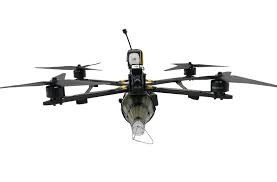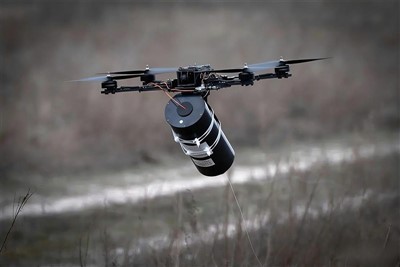

Fiber optic bucket unmanned aerial vehicle is a mainstream combat form of fiber optic unmanned aerial vehicle, specifically referring to unmanned aerial vehicles equipped with cylindrical fiber optic bucket components on the fuselage and connected in real-time to ground stations through ultra-fine high-strength optical fibers.
Basic principles
Fiber bucket release mechanism
High strength optical fibers are precisely wound on lightweight spools, sealed in cylindrical "fiber barrels", and fixed under/at the tail of the drone body. During flight, the cable is synchronously and uniformly laid out by the motor or tension control to ensure that the cable is not tangled, dragged, or broken.
Full duplex transmission of optical signals
The ground station and airborne electro-optical conversion module convert electrical signals into optical signals, which are transmitted through optical fibers using the principle of total reflection of light.
Downward: Real time image feedback from drone camera
Upward: issuance of ground control commands and flight control parameters
High bandwidth and extremely low latency
Flight control
Based on a multi rotor/FPV aircraft as the foundation platform, it relies on rotors to ascend and maintain stable posture; The entire process is directly controlled by ground station fiber optics, without relying on GPS and radio.
Power supply mode
Most: Powered by onboard batteries
High end: Composite fiber ground power supply, theoretically unlimited battery life
Main features
- Absolute anti-interference: No electromagnetic radiation, immune to electronic interference, GPS deception, signal hijacking.
- Communication is extremely secure and stable: signals are enclosed within optical fibers, without leakage, interception, or packet loss.
- Standardization of fiber optic drums: cylindrical lightweight drum body, pre installed with 5-20km fiber optic cables, can be quickly replaced.
- The platform is mainly based on FPV aircraft: compact, high-speed, and highly maneuverable, suitable for reconnaissance/precision strikes.
- The combat radius is limited by the length of the fiber optic cable: generally 2-20km, and cannot fly freely beyond a long range.
- High battlefield survivability: difficult to detect and interfere with by anti drone systems (C-UAS).
- Fiber optic slim and concealed: diameter<0.3mm, difficult to see in the air and difficult to detect by radar.
Application scope
1. Military battlefield (core application)
Frontline precision strike:
Fiber optic FPV traversal aircraft, anti-interference strike against tanks, fortifications, and vehicles.
Complex electromagnetic environment reconnaissance:
Real-time reconnaissance and target identification in strong electronic warfare areas.
City/alley warfare/tunnel breakthrough:
No GPS, no radio, stable operation in enclosed space.
Long term on-site duty:
Ground powered 24-hour uninterrupted monitoring.
2. Public safety and security
Important facility security:
24-hour monitoring of nuclear power plants, prisons, borders, and ports.
Large scale event security:
Anti-interference, no signal conflicts, stable live streaming.
Counter terrorism/hostage rescue:
Indoor/complex terrain covert reconnaissance, real-time high-definition feedback.
3. Industry and Inspection
Power/oil and gas pipeline inspection:
High definition inspection of strong electromagnetic/mountainous environment stability.
Mines/tunnels/underground spaces:
No GPS, no interference, reliable detection.
Fine monitoring of bridges/dams:
Ultra stable real-time transmission of structural data.
4. Emergency rescue
Fire/earthquake/flood:
Real time disaster response in areas with strong interference and no signal
Field search and rescue:
Complex terrain stable reconnaissance, personnel positioning.
Hot Tags: fiber optic barrel drone, China fiber optic barrel drone manufacturers, factory, Fiber Optic Guided Drone, Fiber Optic Drones, fpv drone, Fiber Optic Barrel Drone, FPV Training Drone